John Lewis Gaddis Quotes
If there is one great power, and the great power has taken upon itself the right to preempt and is choosing for itself when and in what circumstances it's going to do that, obviously it leads people in the rest of the world to wonder how far this doctrine extends.
Gaddis, John Lewis. Interview. Frontline: The War Behind Closed Doors, PBS, 20 Feb. 2003.


The Congressman was being critical of the George W. Bush Administration and their tendency to decide which leaders and countries were legitimate and moral and which were not, and then invading the “bad” and executing the leaders as with Iraq and Saddam Hussein.

His appeal was also in the name of concurring heads of state of Finland, Holland, Denmark, Norway, Luxemburg, and Sweden.

The highest court in New York.


This was a warning to Saudi Arabia that the United States might seize the oil fields. At the time we were not getting enough oil for domestic needs and the military in Europe and in Vietnam. The King arranged to secretly supply oil to the United States while maintaining to the other Arab countries that it was maintaining the boycott of the West.
The highest court in New York. This was the generally accepted view of international law until WWII when atrocities and crimes against humanity were coped with. Also, at the time of this writing America was a small emerging state and not one of the great powers. Hence the prohibition of even commenting on the internal affairs of another nation was important to us. Now that America is a superpower, and society is more concerned with human rights, the point of view has changed.


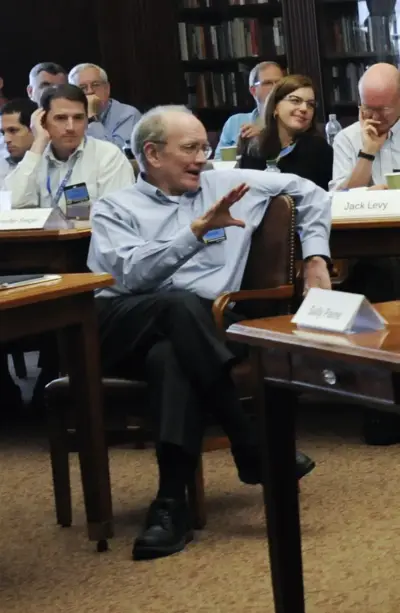
John Lewis Gaddis (born 1941) is the Robert A. Lovett Professor of Military and Naval History at Yale University. He is best known for his work on the Cold War and grand strategy, and he has been hailed as the "Dean of Cold War Historians" by The New York Times. Gaddis is also the official biographer of the seminal 20th-century American statesman George F. Kennan. George F. Kennan: An American Life (2011), his biography of Kennan, won the 2012 Pulitzer Prize for Biography or Autobiography.
