Albert Einstein Quotes
I wouldn’t be Einstein if I kept quiet.
He had publicly been criticizing Hitler and the Nazis in their early years and his wife was concerned that he might be physically attacked. The Queen of Belgium actually assigned bodyguards to protect him. Finally, with a price on his head, he escaped Germany and came to America.
Albert Einstein, 1879-1955, Nobel laureate in Physics, Statement to his wife who was telling him to keep quiet
Sourced by: Eigen's Political and Historical Quotations


The ex-president was speaking at the 9-11 memorial park where American Heroes fought the hijackers who wanted to crash Flight 93 into the White House and crashed the plane with all onboard dead. The Department of the Interior and millions of Americans had planned a memorial, but after 10 years from 9-11, they were still $10 million short of the needed amount. Congress was polarized about spending any money for everything that was not military or security oriented. Millions of other Americans didn’t want the Federal Government to spend another dollar. Politicians were afraid to ask for funds at the time. Clinton endorsed the need for the money from private and public sources and told the politicians, the corporations and the public. He ended his urging with the words of the heroes of the hijacked plan heroes when the decided to fight back, knowing that they would probably die. Clinton’s audience found the speech inspiring and it was far from unpopular, but it was vintage Clinton, at that point, the most popular politician in the nation.


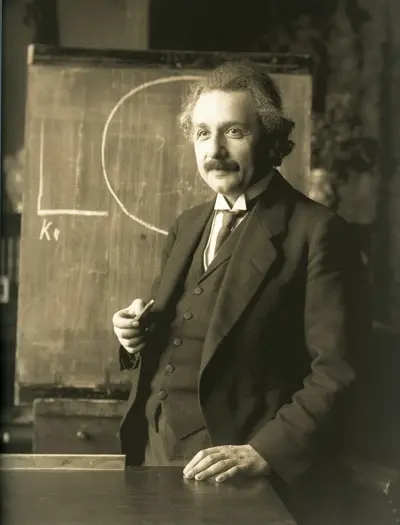
Albert Einstein was a German-born theoretical physicist, widely acknowledged to be one of the greatest physicists of all time. Einstein is known for developing the theory of relativity, but he also made important contributions to the development of the theory of quantum mechanics. Relativity and quantum mechanics are together the two pillars of modern physics. His mass–energy equivalence formula E = mc2, which arises from relativity theory, has been dubbed "the world's most famous equation". His work is also known for its influence on the philosophy of science. He received the 1921 Nobel Prize in Physics "for his services to theoretical physics, and especially for his discovery of the law of the photoelectric effect", a pivotal step in the development of quantum theory. His intellectual achievements and originality resulted in "Einstein" becoming synonymous with "genius".
