Tawakkol Karman Quotes
I would like the world to know that Yemeni women are strong, and if empowered, they can achieve. The world needs to look beyond stereotypes and dress code. In our hearts, we are just human beings who want to live a dignified life. Is that too much to ask for?
Al-Sakkaf, Nadia. "Renowned Activist and Press Freedom Advocate Tawakul Karman to the Yemen Times: 'A Day Will Come When All Human Rights Violators Pay for What They Did to Yemen.'" Yemen Times, 17 June 2010.


He was very conservative in almost all things, but here and with poverty (see {638805}) he was far ahead of his time.


Jinnah was a modern Islamic reformer as this quotation demonstrates. Pakistan is not as backward as most of the Arab Islamic countries on the role of women. There are many Pakistani businesswomen and professionals. Pakistan has even had a female president. However, the fundamentalist Islamic forces that dominate the culture constantly preach and advocate the literal interpretation and following of Sharia which calls for a traditional, subservient traditional role for women; “honor killings” are common; “a rapist cannot be convicted on a female victims testimony; there are calls for the killing of adulteresses and other primitive throwbacks. Jinnah’s vision has not come to pass yet.

Mrs. Roosevelt thought that with the rate of improvement in society’s perception and treatment of women was improving so steadily that women in America were not far from equality. Because of the shortage of men on the home front in WWII women had performed well in virtually all occupations including welding, heavy construction and management and it was just a matter of time to reach equality of pay and parity. However, she and most feminists did not take into account the 2 million men returning from military service who wanted their jobs back. Sexists, who had been suppressed during the war when they objected to women in non traditional occupations, were no longer silenced by national necessity. An occupational backlash developed. Then a sexual one regarding contraception and family planning, (Condoms for example were illegal up to 1963 as birth control device). Each major step forward was accompanied by its own backlash and even in the Presidential Campaign of 2012 contained debate on women’s control over their own bodies relative to abortion and contraception.

Anna Moiseyeva Rosenstein. See {637759} for a similar view from Austria.


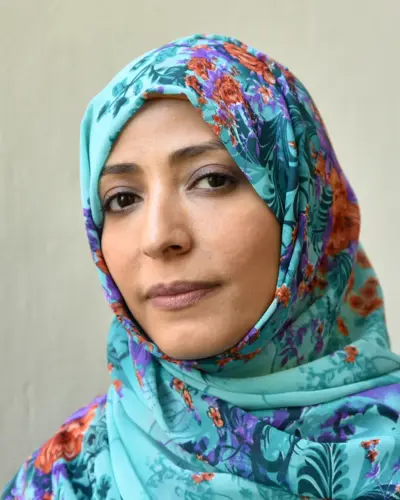
Tawakkol Abdel-Salam Khalid Karman (Arabic: توكل عبد السلام خالد كرمان Tawakkul 'Abd us-Salām Khalid Karmān; also romanized Tawakul, Tawakel) is a Yemeni Nobel Laureate, journalist, politician, and human rights activist. She leads the group "Women Journalists Without Chains," which she co-founded in 2005. She became the international public face of the 2011 Yemeni uprising that is part of the Arab Spring uprisings. In 2011, she was reportedly called the "Iron Woman" and "Mother of the Revolution" by some Yemenis. She is a co-recipient of the 2011 Nobel Peace Prize, becoming the first Yemeni, the first Arab woman, and the second Muslim woman to win a Nobel Prize.
