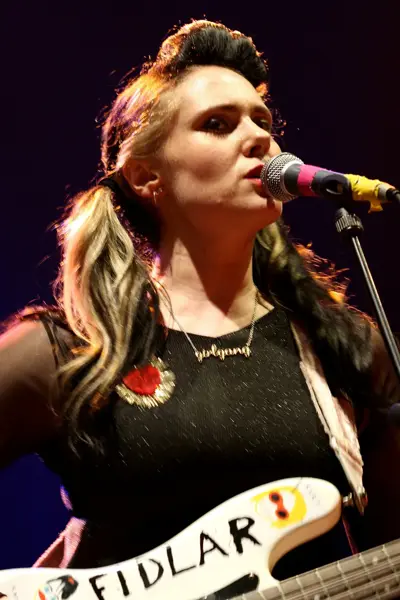
I started my own zine, and riot grrrl became a huge part of my identity.
I loved all that riot-grrl scene and Nation of Ulysses and Bikini Kill and Huggy Bear. I loved it. It was the moment sort of first growing up where bands had stopped looking like roadies.
Punk may have helped me find my voice and made me realise that I had the right to have one, but it was riot grrrl that helped me sustain that voice and shout a little louder.
When I was little I wanted to be like Kathleen Hanna or Courtney Love or be attached to the X-girls and hang out in downtown culture.
When I was 16, 17 years old, I became aware of music coming out of Olympia, Wash., which is the state capitol and about an hour south of Seattle. And there were bands like Bikini Kill and Bratmobile and Heavens To Betsy, and for the first time, I heard my story being explained to me, being sung to me.
I like 'My So-Called Life' and the 'Riot Grrl Movement' and 'Freaks and Geeks.'
I'm not a goddess, for crying out loud. I'm a regular person who took feminism - which I have a deep connection to - and mixed it with music, which I really love to do.
To make riot grrrl move into the future in a new way with a bunch of new names and a bunch of new energy, younger people have to learn about it and apply it to their own lives and own modern conversation. And they are.
There is a lot to say about what Bikini Kill and other 'riot grrrl' bands were able to achieve when they first set out. They were not some momentary, convulsive, creative spasm of independent music. There was a very real, relevant point of view being expressed.
I loved Riot Grrl. Not only was it a punk rock revolution, but it meant you could get dressed for a night out for less than two pounds!
I don't mind the term 'feminist.'
It's like our little thing: you can take the girl out of the punk, but you can't take the punk out of the girl.
I did have a feminist side to me, just not in such a pronounced way.
Whenever a woman describes herself as a 'post-feminist' I picture women lashed to posts. Joan of Arc was an early post-feminist.
I never set out to write a book to change women's lives, to change history. It's like, 'Who, me?' Yes, me. I did it. And I'm not that different from other women. Maybe my power and glory was that I could speak my truth as a woman and it was the truth of every woman.
The purpose of feminism is to free the uniqueness of the individual and to understand that inside each of us is a unique human being who is a combination of heredity and environment.
I'm a feminist. I've been a female for a long time now. It'd be stupid not to be on my own side.
PUNK IS: the personal expression of uniqueness that comes from the experiences of growing up in touch with our human ability to reason and ask questions.
Contemporary feminism cut itself off from history and bankrupted itself when it spun its puerile, paranoid fantasy of male oppressors and female sex-object victims. Woman is the dominant sex.
I have to ask myself, Am I content with calling myself a feminist? Yes, because I speak out.
I consider myself a feminist, in a way.
I don't necessarily think of myself as a feminist, but I'm a whole person. I'm not just breasts or ass or thighs - I'm a whole being! And it just seems like women aren't necessarily striving to be the whole of themselves.
There's a voice inside of me that I know people will relate to; I just haven't really had the opportunity to let it flourish. To sit there and explain to a guy what it's like to be a kick-ass woman is hard. I think there're only a handful of directors out there that get it.
There's no doubt about it... I was born a feminist.
When I was 19 or 20 and doing my thing, I can't sit here and say I had this strong political agenda - I was literally just being myself.
Every woman in this world is allowed to define themselves how they want.
Kate Marie Nash is an English singer, songwriter, musician, and actress.