Anjem Choudary Quotes
I don't think Muslims can co-operate with police.
This was his response when asked if he would inform the police of another suicide bombing mission by Islamic terrorists.
Anjem Choudary, British Attorney & Islamic Leader of Al-Mahajiroon Extremist Organization, Quoted in The Sun, January 21, 2007
Sourced by: Eigen's Political and Historical Quotations


al-Mansur Abu Ali. Even though the Caliph was trying to return to Muslim Fundamentalism, there was a general tolerance that was far in advance of Christian societies at the time. It is dramatically at variance with many of the more rigorous Islamic countries today.

This sura illustrates why peace treaties between Islamic and non Islamic countries are difficult to negotiate and enforce. For some fundamentalist Muslims, even making a peace treaty with Israel would constitute a transgression of the word of God. Nonetheless, the first treaty that the United States ever made was with a Muslim nation—Tripoli.

In his version of Islamic logic, since non-Muslims are heretics they should be subjected to capital punishment anyway so there is no such thing as an “innocent” Christian, Hindu, Bahai or Jew. This is an extreme position held by very few of the English Muslims but unfortunately held by radical Islamic extremists in many counties.


This is a remarkable quotation. Here was a leading minister of the Established Church of England who is arguing that there should be no established church insofar as religious belief is concerned. Essentially this is what England has developed. The Anglican Church is still the established church but only for purposes of state cerimonies and the religion of the Royal Family. The establishment has nothing to do with lawmaking, or common religious belief or inhibition of the many other religions in England and there is complete freedom of conscience.
In one of the historical ironies of the 12th century, a Christian sect preferred the rule of the Muslims than their Christian brethren—on the grounds of religious tolerance. It illustrates the changes that take place over time. By the 21st century, it was the Christians who were thought of as tolerant and the Muslims as the opposite.

The following year India was partitioned and millions of Hindus were slaughtered by Muslims and vice-a-versa.

New Lanark was a Utopian commune organized by Owen.


Half the population of Amsterdam was at the time non Western in origin including many Muslims. Cohen was one of the few major Dutch leaders who worked to make multiculturalism work. However, there were so many religious Muslim extremists already active in the Netherlands, that it was very difficult. The Dutch had elected a Muslim as a member of Parliament and whole many Muslims were very proud of this, the religious extremists were furious. She was a woman, and she did not believe or advocate that Holland adopt Sharia (Islamic) law. She was an Islamic reformer who was opposed to Sharia even in Muslim states. The most successful Islamic nation, Turkey, does not allow Sharia law, and Indonesia, the largest of the Muslim nations also does not follow it.
While the violence between the two religious groups had been eliminated by the peace negotiations, the two religious groups were as socially and physically disparate as they had always been.

He is a Greek Orthodox Christian, and he correctly observes that the Islamic world was considerably more tolerant than the Christian until the 18th century when Islam had become less tolerant in the Middle East while the Christians were modernizing and going through a cultural and intellectual enlightenment and societal modernization while the Muslims, became less tolerant than they were in earlier years leading to the modern situation.

He was the elected Mayor of London at the time.

Many, if not most, non-Muslim scholars and thinkers very much disagree with Hamid on this point. The great exceptions of Islam are almost 1,000 years in the past. Current Islam, they argue, is not more exceptional than the beliefs of modern Mongolia which dominated most of the known world centuries ago, but has little that deserves special respect in the 21st country beyond the general respect which is owed to all religions and nationalities. With the exception of Turkey, Islamic nations are for the most part, backward, and virtually no other non-Muslim nations try to emulate them in any way.


Toleration is a relative term. The Muslim Moors made Christians (and Jews) pay a special tax. At times they were forced to wear special clothing so that they could be readily identified. And they could not build churches larger or taller than the smallest mosque in the community. At times, their occupations were restricted but at other times Christians and Jews were appointed to the highest positions like Vizier. The Inquisition, in contrast, forced all Muslims (and Jews) to leave the country without any of their property or money or be tortured and killed—usually by burning at the stake unless of course that they converted to Christianity.
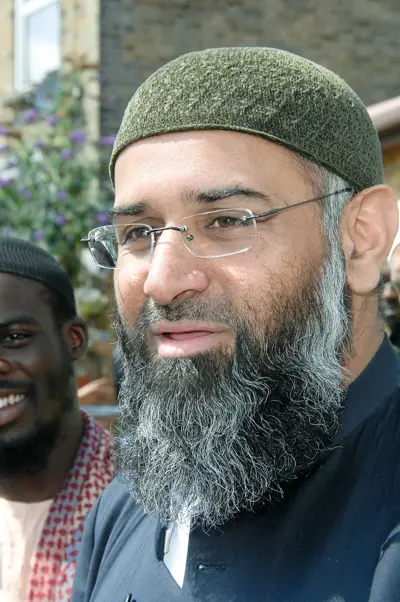
Anjem Choudary is a British Islamist and a social and political activist convicted of inviting support for a proscribed organisation, the Islamic State of Iraq and the Levant, under the Terrorism Act 2000. He was subsequently subject to sanctions by both the U.S. State Department and the U.N. Security Council freezing his assets.
