I didn't learn the word 'genre' until way, way late - I mean, like, in the '80s.
I didn't know what the word 'genre' meant till I was twenty years old.
I love the idea that all genres can have subsets.
I don't really classify 'Wichita Lineman' as country.
There's no such thing as the contemporary novel. Before I seem the complete reactionary, let me add that I've happily joined in many discussions about 'the contemporary novel' where what that usually, unproblematically means is novels that have appeared recently or may appear soon.
As far as I am concerned, I write novels, and other people can do the labelling.
I've been building a fiction in part around the Marfa poem since my brief residency there, which has kept it from receding into the past.
All art is autobiographical - if it's not, it's not going to quicken on-stage, and it's not going to come alive.
Things need to be properly named. Political confusion starts with terminology confusion. Islamism implies some sort of political and social plan for Muslim people. In that classification, we find different categories. Legalist ones, traditional ones and revolutionary ones. Some of them are revolutionary but are non-violent, others are extremely violent. There are also the ones we call the literalists, like the Egyptian party Hizb al-Nour that used to be against democracy and now is getting into the political game.
Race designation is a political designation.
…my life has been a remarkable one. Maybe one day someone will write a book about me . . .” "I’ve never much cared for horror stories.
I kinda write in sequences that I live through.
I think what's happening is, it's all - fantasy, science fiction, ghosts, trolls, whatever - finally being called, being admitted to be literature. The way it used to be, before the Realists and the bloody Modernists took over.
Memoir implies the need to reveal something about yourself - to recount your life for educational purposes.
In New York, I was excited about the music in New York because the only music that I was more or less involved with in the South was either country and western or hillbilly music as we used to call it when I was a kid and, ah, gospel. There was no, there was no in between. And when I got to New York all the other musics that's in the world just came into my head whether it was the classics, jazz, I never knew what jazz was about all, had heard anything about jazz.
I feel I've always been writing about self-identity. How do we become who we are? So I'm just writing from experience what's concerned me.
I've always felt that blues, rock 'n' roll and country are just about a beat apart.
In the middle years of the nineteenth century there first became abundant in this strange world of ours a class of men, men tending for the most part to become elderly, who are called, and who are very properly called, but who dislike extremely to be called--"Scientists.
Start telling the stories that only you can tell.
I listen to the radio and I like all kinds of music, you know, but I like to hear from people who have been there. Hank Williams has been there.
I think that the people who put caps and the people who put genres on music are the people who are killing our music industry.
All writers steal from their own lives.
What did I think of Princeton? Well, the answer to that question requires a story. When I first arrived, I looked around me at the Gothic buildings - younger, I later learned, than many of the mosques of this city, but made through acid treatment and ingenious stone-masonry to look older.
Know your genre. Know your history. Read a book.
Mine (story) ain't the scariest, the clearest, the most painful, or the most beautiful. It just happens to be the one that's got it's fingers around my throat.
I'll be at Lambeth telling my story
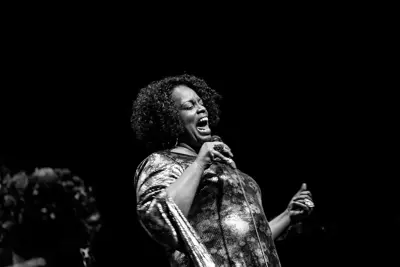
Dianne Elizabeth Reeves is an American jazz singer.