Friedrich Nietzsche Quotes
I call Christianity the one great curse, the one great intrinsic depravity, and the one great instinct of revenge, for which no means are venomous enough, or secret, subterranean and small enough - I call it the one immortal blemish on the human race.
Nietzsche, Friedrich. The Antichrist. Translated by Walter Kaufmann, Viking Press, 1954, Section 62, p. 656.


The institution to which he was referring was the University of Virginia which Jefferson founded. This letter shows Jefferson’s personal antipathy to the theologians of the day. It is uncharacteristically not as tolerant as most of us would associate with Jefferson. However, by this time in his career, he had become used to being the major political enemy of most orthodox clerics. He didn’t want them in his beloved university.


Bashir advocates adapting Sharia—Islamic Law—for all people in Indonesia—regardless of their religion or their preference for separation of church and state. This is diametrically opposite to an Islamic Syrian poet of 1000 years ago—see {624477}. Many Muslims have become more intolerant than some of their earlier scholars. Bashir also differs from most Indonesian Muslims who have historically not shared his bigotry and intolerance.
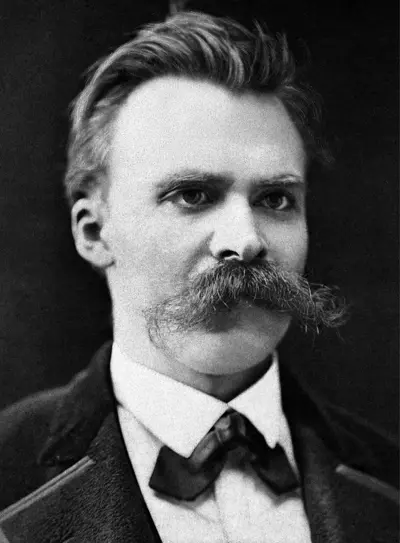
Friedrich Wilhelm Nietzsche was a German philosopher, cultural critic, composer, poet, writer, and philologist whose work has exerted a profound influence on modern intellectual history. He began his career as a classical philologist before turning to philosophy. He became the youngest person ever to hold the Chair of Classical Philology at the University of Basel in 1869 at the age of 24. Nietzsche resigned in 1879 due to health problems that plagued him most of his life; he completed much of his core writing in the following decade. In 1889, at age 44, he suffered a collapse and afterward a complete loss of his mental faculties. He lived his remaining years in the care of his mother until her death in 1897 and then with his sister Elisabeth Förster-Nietzsche. Nietzsche died in 1900.
