Steve Wozniak Quotes
I believe you should have a world where you've got to license something at a fair price.
Wozniak, Steve. Interview. Bloomberg, 2012.

The Black Plague, which raged in Europe from 1347 to 1349, had left relatively few able bodied people alive. Given this shortage of labor there was a rapid inflation, especially to the distress of the landed class who had to pay much more for their food. The king therefore established what amounted to price controls, wage controls and forces labor. See {611125} and {611126}


Manava Dharma Shastra. Ancient Hindu India had what may well have been the most regulated mercantile economy of any society in history. All prices for all goods were to be set by the king. In order to prevent the stultifying effect of price controls, the Hindus required that the prices be reset very frequently to reflect various market conditions. It was a highly regulated form of capitalism. This text is a part of the Hindu Holy Texts. Hindus believe that Manu was a prophet whose text is revealed or inspired.

Brandeis was U. S. Supreme Court Justice Louis D. Brandeis, 1856-1941, who wrote that competition would control prices if only healthy competition could be maintained—the problem was resolved by both increasing competition and much more stringent regulation of corporations.


Whenever price controls have been tried, there always seems to develop a black market. However, some argue that price controls can work very well for a modest period of time in a national emergency and give WWII as an example. Although there was a black market, very few Americans participated in it, and the effect was positive as a result of the patriotism that was so keenly felt by most Americans at that time. Further, capital punishment has rarely worked to prevent any illegal activity. In London, pickpockets were publicly hung while other pickpockets fleeced the crowd watching the hanging ostensibly to dissuade people from pickpocketing.


The prime minister had a political and philosophical position that government should not interfere with or set or control pricing in the economy. However, a scandal broke out involving payday lending—short term lending the working class does to tide them over till pay day if they run out of money. Lenders were charging huge interest rates beyond anything that is conscionable. Cameron’s government placed controls on interest rates and other facets of that industry as they might have lost a vote of confidence in Parliament had they not acted. He was then questioned about the hypocrisy involved in his regulation, and he gave this amazing quotation, which was the classic reason for government price controls on the private sector that had been given by the Labor Party opponents for years. This also distressed extreme conservatives, who argue that market controls are always preferable to government controls.

That philosophy became embedded in most of our utilities and necessary services. With electricity, the people who live in dense population clusters pay more so that rural residents can obtain electricity at reasonable prices. Internet, cable TV, and telephone are similar. In pharmaceuticals, Americans pay much higher rates while 3rd world countries pay less than their share. The communities who invested in water infrastructure early are today subsidizing those communities who invested little. And people who live in areas of easy water availability subsidize people in the areas where they have abused their water resources or had few to begin with. People who live in safe areas subsidize people who choose to live in flood planes or box canyons susceptible to fires by paying more for insurance so the people in high risk areas can obtain affordable insurance.


She was then the European Commissioner for Competition.

Although his title was “Deputy Governor” he was the highest ranking official of the British Government in Pennsylvania so he is often referred to as “Governor”. Many of his views came from the English Civil War Radicals. He organized a “Leather Apron Club” in Pennsylvania.

The “regulation” to which Franklin objected was not the type of regulation we have today. It was generally limited to the granting of monopolies to individuals or their companies if they would institute a service that was perceived as beneficial by the public as a whole. For example, a company might build steamboats and provide regular service across a river or along it. The company would argue that the initial cost and investment is so great, that they are entitled to a period of protection so that they can be sure of getting their investment back. In most cases, they would have made the investment, monopoly or not, and in many cases the public officials are unsophisticated and make a bad deal; in others there was (and is) outright corruption. Countries like Norway, have been so burned by the problem Franklin observed, that they try to avoid even government monopolies of service. They for example, have private and public light rail commuter lines which continuously compete against each other.


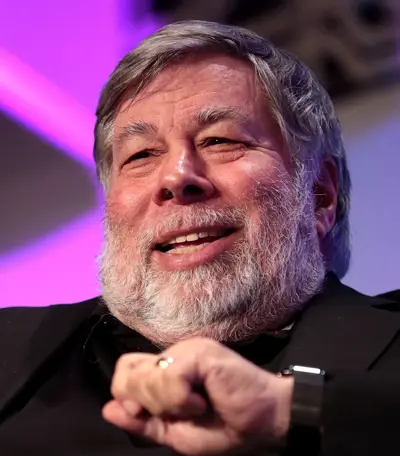
Stephen Gary Wozniak ,(p18)(p27) also known by his nickname "Woz", is an American electronics engineer, computer programmer, philanthropist, and technology entrepreneur. In 1976, he co-founded Apple Inc. with business partner Steve Jobs, which later became the world's largest information technology company by revenue and the largest company in the world by market capitalization. Through their work at Apple in the 1970s and 1980s, he and Jobs are widely recognized as two prominent pioneers of the personal computer revolution.
