Plutarco Elias Calles Quotes
I am always on the side of labor when there is any compromise to be made.
Plutarco Elias Calles, 1877-1945, President and Dictator of Mexico, Statement to the Press, 1927
Sourced by: Eigen's Political and Historical Quotations

He had squads of thugs that he would “rent” out to other gangsters for their enforcement activities and to unions to protect themselves from goons and intimidate non union workers. However, he would not let his men work as goons and strike busters or for companies—despite huge pay offers—to keep their workers in line, a common practice at the time.
Two years later he was assassinated.


This quotation was reprinted and widely distributed by the CIO in its 1936 organizing drive of the Ford Motor Company

Vladimir Lenin


Big Bill Haywood. Historically, the upper economic and business class, including currently, tend to view all labor organizations and unions as socialistic and or communistic and attach them for being such. However, in many industries in America today labor has a great deal of power and the industries are not socialistic or communist. The IWW however was one of the labor organizations that was based on socialism and contained many communists over the years. Haywood himself was a leader of the Socialist Party and campaigned for Eugene Debbs. Like Debbs he was convicted of an unconstitutional law of speaking against the WWI draft. Unlike Debbs who went to prison and was released later, Haywood skipped bail and lived in Russia for the rest of his life.


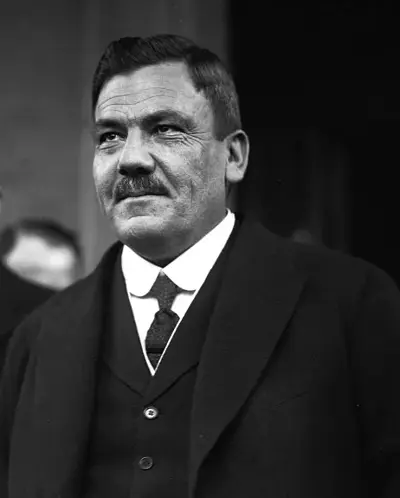
Plutarco Elías Calles was a Mexican military general and politician. He was the powerful interior minister under President Álvaro Obregón, who chose Calles as his successor. The 1924 Calles presidential campaign was the first populist presidential campaign in Mexico's history, as he called for land redistribution and promised equal justice, more education, additional labour rights, and democratic governance. After Calles' populist phase (1924–1926) he ushered in a state atheism phase (1926–1928), ushering a period of persecution against Catholics. After leaving office he continued to be the dominant leader from 1928 to 1935, a period known as the Maximato, after a title Calles awarded to himself, Jefe Máximo (Maximum Chief) of the Revolution. Calles is most noted for his implementation of anti-Catholic laws in the Mexican constitution. This led to the Cristero War, a civil war involving Catholics opposed to the administration. Calles also founded the Institutional Revolutionary Party in 1929. The party had ensured political stability in the wake of the assassination of president-elect Alvaro Obregón in 1928. In its two subsequent incarnations, it held power continuously from 1929 to 2000.
