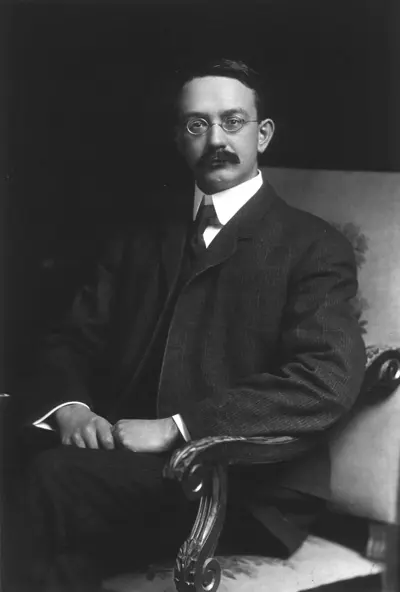
Edwin Grant Conklin Quotes
Heredity is to-day the central problem of biology. This problem may be approached from many sides—that of the breeder, the experimenter, the statistician, the physiologist, the embryologist, the cytologist—but the mechanism of heredity can be studied best by the investigation of the germ cells and their development.
This quotation illustrates how the priorities of science change over time as a result of learning more and developing new techniques and tools.
Edwin Grant Conklin, 1863-1952, Biologist, “The Mechanism of Heredity”, Science, 1905
Sourced by: Eigen's Political and Historical Quotations


As early as this was in scientific history, he essentially described the process whereby new species are formed by the mutation from the old series.


Venter developed an entirely new method of finding new species and hence new genes by collecting water samples from all over the world and using computers to catalog all the life forms and determine whether or not each is new and then isolating the genes if unique. As a very wealthy business man he had a personal sailing yacht which he turned over to graduate students and young scientists who then sailed much of the world taking indiscriminate samples, preserving them and sending them back to Venter’s computer bank for analysis. The cost per gene and specie discovered was amazingly small as it was an industrialization of finding new life forms.


This quotation is important for two reasons. First, it appears to be the first use of the nature-nurture words to discuss this concept. Second, this “conclusion” started one of the longest running scientific debates in biology—nurture vs nature.

See President Clinton’s quotation at the same press conference {628400}.


Darwin’s work had polarized England into two camps. Spencer was one of the major public supporters of Darwin. Tennyson expressed a similar intuitive view a decade earlier {627586}. Spencer reasoned that if an egg cell and a sperm cell could produce a human in 9 months, why was it not plausible that the cell could become a human in hunreds of millions of years.


Darwin who had a Protestant Christian upbringing, never precluded the possibility that God had created the universe with the Laws of Evolution and that was the mechanism He selected to allow all the species and diversity of life to develop. But he did not say that explicitly. While he found immediate acceptance and accolades from the scientific communities throughout the world, and enthusiastic approval by most educated people with the exception of theologians and clerics. Their reaction was extreme—almost apoplectic. The book as a best seller and they sold out with each successive printing. In the 6th edition, Darwin not only was explicit about the role the Deity might have had, but Darwin stated that he personally believed that He was the impetus to the creative process. Ironically, almost all the social and political opponents of Evolution have never read Darwin’s work (or much else on the subject) and certainly do not realize that the man they accuse of leaving God out of the Creation, actually believed that God was the critical element and he and other evolutionary scientists were just discovering God’s laws. Dr. Huxley and some other supporters of Darwin were disappointed with this change in the 6th edition, as they were atheists and believed that there was no deity involved in the creation. Today, there are evolutionary scientists who are on both sides of the issue. They just disagree on this point, but they work together on everything else.