Roger Williams Quotes
God requireth not a uniformity of religion.
Williams, Roger. The Bloudy Tenent of Persecution, for Cause of Conscience. London, 1644.


At the time there was an issue of religious freedom that is in public discourse: It emanated from the Obama Care law which required employers to provide health insurance that does not discriminate against women by refusing to disallow coverage for birth control (pills, diaphragms, etc.) This legislation covered the employees of general institutions run by religions such as schools, hospitals, and retirement communities. Roman Catholics and other religions which viewed birth control as a sin were put in a position where they had to pay for something that they regarded as sinful. So the church did not have complete religious freedom. However, if these institutions would deny to their employees a basic right that the law says belongs to all institutions. If an exception would be made for birth control what about blood transfusions. The Jehovah’s Witnesses believe that autologous blood transfusions are contrary to the world of God. So what if institutions they run decided to not cover these transfusions in their insurance policies? Or a Jewish University or a Muslim cultural center decided not to cover medical procedures in hospitals that serve pork? There have been many examples where one religion’s freedom has been curtailed slightly when they conflict with individual rights or other rights. Plural marriage for Mormons and Muslims are against the law. Christian Scientists have been forced to provide medical care for some members even though their religion prohibits it. There is no solution that will not curtail someone’s rights under some circumstances.
This book is endorsed by major religious organizations of all faiths as well as National School Boards Association, National Education Association, National PTA, National Association of Secondary School Principals, National Association of Elementary School Principals, American Association of School Administrators and others. It is used as a guideline by most schools systems in the United States.


Anne was a Protestant but her father James II was a Roman Catholic. There was always suspicion about her true religious allegiance by the extremists in the Church of England. The Act of Toleration, despite its name, required the Church of England to be the established church and the sovereign’s to be the heads of the church.


Pen name: Jack Nipps. Leland was a Baptist evangelist who had worked with Thomas Jefferson and James Madison to secure Freedom of Conscience in Virginia. Many people think that ideas such as this are the views of irreligious men and women, but Leland was a devout, evangelical Baptist and Baptists suffered discrimination in early Colonial America. Freedom of conscience was essential for all religions who were not in the local majority. Tolerance essential. See 43,065.


Benjamin Franklin used almost the exact statement in a dispute of the Catholic Schools in the same year. It was unlikely that Frederick followed American politics so closely that he would have learned of Franklin’s statement, but Franklin was attuned to all the events of Europe, and this official act of the Emperor was big new for religious toleration enthusiasts. Therefore we suspect that Franklin was quoting Frederick without attribution.

Those who claim that the founding fathers contemplated religion as a critical component of government often point to this article of the South Carolina Constitution. However, they ignore the almost simultaneous passage of the New York constitution as in {612166}. When the framers of the Constitution met in 1787 in Philadelphia the separation of church and state issue was not really resolved and awaited the Bill of Rights where the separatists won out.

It is an error to say that. It is an error to say that He was the last Pope to hold temporal power. Years later, the Vatican rejected this view and adopted the modern concept of freedom of conscience. See {612714}.

Quintus Septimius Florens Tertullianus. This quote is historically very important as it is one of the first expressions of religious tolerance. Tragically, this principle was ignored by most Christians for over a millennium. Some Christians still ignore it. See {626754} for a modern example.

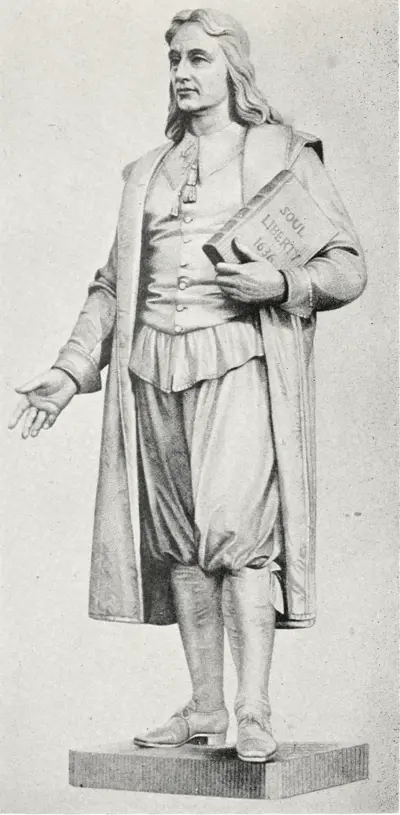
Roger Williams was a Puritan minister, theologian, and author who founded Providence Plantations, which became the Colony of Rhode Island and later the U.S. state of Rhode Island. He was a staunch advocate for religious freedom, separation of church and state, and fair dealings with Native Americans.
