Karl Marx Quotes
From each according to his ability, to each according to his needs.
While Blanc appears to have originated the famous phrase 35 years earlier, most people associate it with Marx. While not quite the exact same meaning, compare with Thoreau: {35837}
Louis Blanc, 1811-1882, French Socialist and Writer, The Organization of Work, 1840Karl Marx, 1818-1883, German Economist & Socialist, Critique of the Gotha Program, 1875
Sourced by: Eigen's Political and Historical Quotations

This was a clever take-off on the famous Marx quotation {584427}


later also a song sung at his campaigns and rallies


The Income tax had been ruled Constitutional by the Supreme Court in 1881, but the then “new” Court—the one that would render the Plessy v. Furgeson decision—was a more conservative one. By a 5-4 partisan decision, the Supreme Court reversed itself and killed the income tax until a Constitutional amendment could be passed 19 years later in 1913.

Ironically, at the time the great worry was the ability to produce sufficient food for the whole world. Today, we find that task relatively easy, but we still have malnutrition and starvation on some parts of the world. Supply is only one factor. Distribution is as critical.

This line was used at his trial to show that he had communist tendencies. He and the 9 others refused to answer a Congressional Committee’s questions about their political beliefs and affiliations. Trumbo served a year in jail for Contempt of Congress and then was blacklisted for years, but he was so good that Otto Preminger broke the Blacklist and hired him whereupon he was employed in many of the major films. He had actually won an Academy Award writing under the name of Robert Rich.

Essentially, this has not changed even into the 21st century.


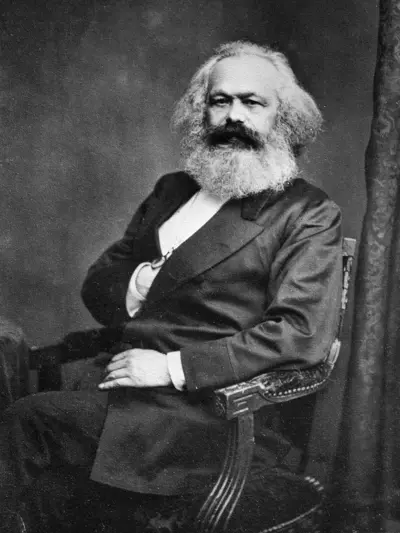
- Born: May 5, 1818
- Died: March 14, 1883
- Nationality: Prussian
- Profession: Philosopher
Karl Heinrich Marx was a German philosopher, economist, historian, sociologist, political theorist, journalist and socialist revolutionary. Born in Trier, Germany, Marx studied law and philosophy at university. He married Jenny von Westphalen in 1843. Due to his political publications, Marx became stateless and lived in exile with his wife and children in London for decades, where he continued to develop his thought in collaboration with German thinker Friedrich Engels and publish his writings, researching in the reading room of the British Museum. His best-known titles are the 1848 pamphlet The Communist Manifesto and the three-volume Das Kapital (1867–1883). Marx's political and philosophical thought had enormous influence on subsequent intellectual, economic and political history. His name has been used as an adjective, a noun, and a school of social theory.
