Richard A. Posner Quotes
Formalist judges needlessly complexity the law in part to avoid the struggle to understand the complex real-world environment that generates much of the business of the modern court.
Richard A. Posner, Judge, United States Court of Appeals, Reflections on Judging, 2013
Sourced by: Eigen's Political and Historical Quotations


The New Deal liberal Democrats had complained that the Supreme Court was making national policy and law and not interpreting law. They tried to pack the Supreme Court by adding more justices who would be more sympathetic to the New Deal. (See {587549}.) At the beginning of the 21st century it was the conservative Republicans who were making the same claim that the Supreme Court was making law and not interpreting it. The pattern seems to be when the court votes for your side, they are interpreting the law. When they vote for the other side, they are activist—making law improperly.


In the 1970s in America conservatives were complaining about judicial activism by liberal judges while in England at the time liberals were complaining about conservative judges’ judicial activism.


He served on a Supreme Court that was as close to political as any had ever been. Hence his great concern.


In 2002 the corrupt Indonesian Courts ruled that a very solvent Canadian company Manulife was bankrupt so that others could get control. The international financial and political community wanted the Indonesian government to intervene and reverse the rulings, but historically the courts had no independence and had been tools of the government.

White was not confirmed.


At the time he was not an official of the bar association.


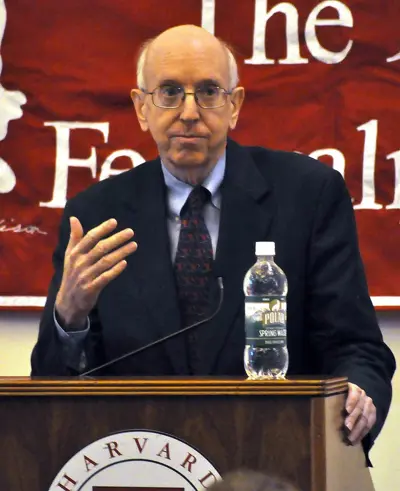
Richard Allen Posner is an American jurist and economist who is a senior lecturer at the University of Chicago Law School. Between 1981 and 2017, he served as a United States circuit judge of the United States Court of Appeals for the Seventh Circuit in Chicago. He is a leading figure in the field of law and economics, and was identified by The Journal of Legal Studies as the most cited legal scholar of the 20th century. He is widely considered to be one of the most influential legal scholars in the United States.
