Jan Hus Quotes
For whoso dies for Christ, he is conqueror and is delivered from all misery and attains the eternal joy to which may it please our Saviour to bring us all.
Hus, Jan. The Letters of John Hus. Translated by Herbert B. Workman and R. Martin Pope, Hodder and Stoughton, 1904, p. 257.


These “benefits” as well as males getting 72 virgins are constantly told to young and impressionable Muslims, some of whom take it so literally that they become suicide bombers. They actually believe that blowing themselves up feels only like the sting of a mosquito. This sales pitch for suicide bombers and other martyrs is also effective because with the poor education, high unemployment, and few political and civil rights, most young Arab males have no other way of obtaining “honor, dignity, and respect.”


The Christian Crusaders then believed, like many Muslims even in modern times, that the person who dies in Battle defending God and the Faith shall ascend immediately to paradise. The Muslims threw in many virgins to go along with the ascendency, but the basic idea was the same.

Odo of Chatillon-Sur-Marne. Westerners who look with horror at the religious promises of Islamic clerics that suicide bombers and other Muslims who die “defending Islam” will immediately pass to Paradise without the usual requirements and judgments which might deny admission because of previous sins. However, this is exactly what the Christians did in the Crusades as this well documented quotation demonstrates. To see the Islamic version, go to {617166}
Martyrs to most Muslims are people who die when defending Islam, which includes under the definitions of the Muslim Fundamentalists murdering innocent civilians including women and children. In addition to ascending directly to heaven, the male martyr gets 72 virgins in Paradise.


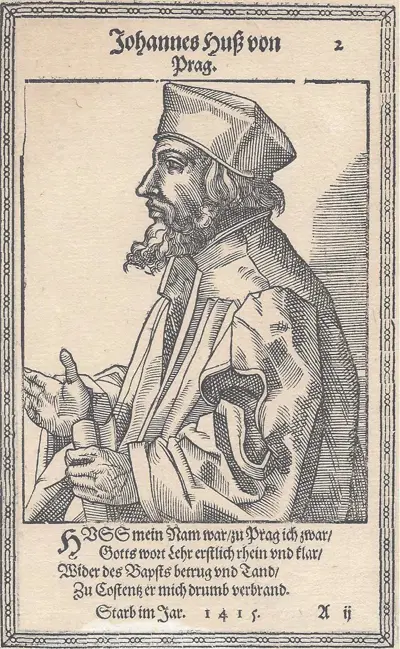
Jan Hus, sometimes anglicized as John Hus or John Huss, and referred to in historical texts as Iohannes Hus or Johannes Huss, was a Czech theologian and philosopher who became a Church reformer and the inspiration of Hussitism, a key predecessor to Protestantism and a seminal figure in the Bohemian Reformation. After John Wycliffe, the theorist of ecclesiastical reform, Hus is considered the second Church reformer, as he lived before Luther, Calvin and Zwingli. His teachings had a strong influence on the states of Western Europe, most immediately in the approval of a reformed Bohemian religious denomination and, over a century later, on Martin Luther. Hus was a master, dean, and rector at the Charles University in Prague.
