Richard P. Feynman Quotes
For a successful technology, reality must take precedence over public relations, for Nature cannot be fooled.
Also published in What Do You Care What Other People Think, 1988. This was his last publication. He realized that NASA was under so much political and public relations pressure, that important science issues could not be faced squarely. So he wrote his own appendix to the report which was embarrassing to some of the administrators and contractors but was really appreciated by almost all of the scientists and engineers.
Richard P. Feynman, 1918-1988, Nobel Laureate in Physics, Member, Commission investigating the Challenger accident, Last paragraph of his personal appendix to the Commission Report on the Challenger, June 9, 1986
Sourced by: Eigen's Political and Historical Quotations


The conclusion that almost all scientists who have studied the problem of climate change and global warming us that there is a substantial change ongoing. That conclusion is reached as the result of literally thousands of observations and studies about the many aspects of climate change. Like any other science, a number of studies have flaws and there are many who fear that government funds will be used to cope with climate change at a cost to the economy. They point to the flaws of individual studies or researchers and have spent millions of dollars to produce uncertainty into the mind of the pubic and politicians. Science, however, ALWAYS has uncertainty and flaws are ALWAYS discovered in established scientific principles. It does not mean that these larger theories and principles are wrong if several of the studies or points are wrong and are understood in a larger and more sophisticated context. Einstein’s Theory of Relativity could be foolishly be called wrong because Einstein did not take account of what would become Quantum Mechanics and there were some contradictions. None the less Relativity is still the most important physical discovery of all time and influences all thinking in physics even though he could not account for the very small physics of quarks, electrons and other atomic particles.


Federal Authorities arrived with press officers and a bevy of reporters and issued statements to the press while there were thousands of people in dire straits with many of them dying with no food, medical care or relocation from flooding water.


Many companies appear to be doing much better than they really are. Often they employ PR professionals to create that impression. Some companies are not even solvent, but the only way we can all tell is to have a recession generally or in that particular sector—the equivalent of the tide going out.


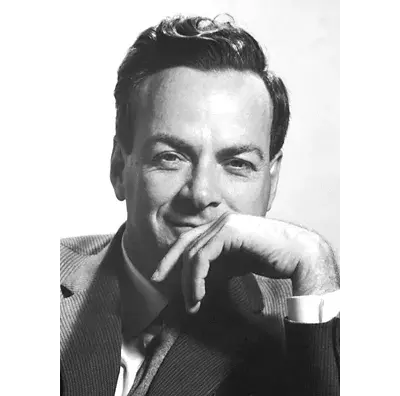
Richard Phillips Feynman was an American theoretical physicist and Nobel Prize winner who made significant contributions to quantum mechanics, quantum electrodynamics, and particle physics. He's known for his work on the Manhattan Project, developing Feynman diagrams, and explaining the interactions between light and matter. While studying for his PhD, Feynman participated in the Manhattan Project and helped develop the atomic bomb. For contributions to the development of quantum electrodynamics, Feynman received the Nobel Prize in Physics in 1965 jointly with Julian Schwinger and Shin'ichirō Tomonaga.
