Irish National Land League Quotes
First—to put an end to Rack-Renting, Eviction, and Landlord Oppression. Second—To effect such a radical change in the Land System of Ireland as will put it in the power of every Irish Farmer to become the owner, on fair terms, of the land he tills.
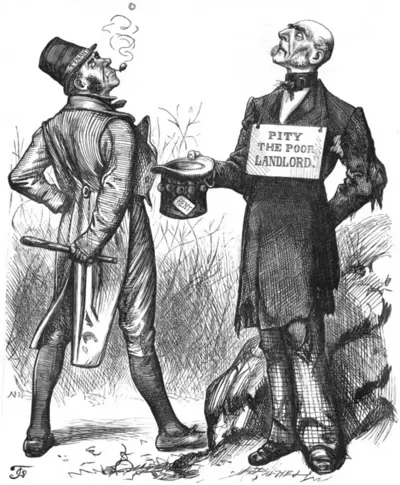
Rack-Renting was the term for a Landlord charging the Tenant farmer an exorbitant rent per year for the right to farm and live on the land. Often the rent for a single year would be an amount equal to the fair market value of the purchase of the entire property, but the Landlords would never sell. The tenant farmers rarely had any alternative as that land had their home such as it was and provided their meager living which generally was only slightly more than the Rack Rent. The Irish National Land League was created to reform the land use and allocation system of Ireland.
Irish National Land League, Purposes, October 1879
Sourced by: Eigen's Political and Historical Quotations

Landlords would abuse tenant farmers {639644}, and then evict them from their home and farm when they could not pay the rack-rents. The Land League fought back. When a landlord evicted a tenant, they would “urge” all other farmers not to rent that farm. If they did, they might be identified and bad things might happen to their livestock or crops. Few would rent a farm where the previous tenant had been evicted after this “program”.

He had just been released from jail for urging mass demonstrations to prevent tenant farmers from being evicted.


In Burundi, family land is divided among the male children of a family. The average Burundian woman has 6.3 children at that time, nearly triple the international fertility rate. With this population growth rate, the plots of land for each person inevitably get smaller and smaller over time. At 10,745 square miles, Burundi is slightly smaller than the U.S. state of Maryland, but it holds nearly twice as many people: about 10 million. The small plots of land are inefficient to farm and provide subsistence. So the nation was in a crises as there was little industrialization and land was essential for existence for most Burundians. See {35807} and {35808}.
Fixed tenure meant leases for a significant period of time. For various reasons, Irish landowners were reluctant to invest in improving property in any way. It the tenant invested his own sweat or resources to improve the property, the landlord would evict him and rent to someone else for more money for the “improved” property. So no one would ever improve property until there were laws requiring tenants to have rights of transfer, inheritance and reasonable fixed lease terms.
Nelson was referring to the past. The industrial revolution created other forms of wealth and power as a huge factory could be built on a small piece of land. In farming, the yield is proportional to the acreage tilled. Not so in manufacturing. With the knowledge era, intellectual property could produce much wealth and power, and factory size and land ownership was not necessary.


In every society where there had been past unjust ownership of land, all efforts of land reform were faced with the problem of having to dispossess the current “owners” who themselves had not been guilty of the crimes of their ancestors in unjustly obtaining the land originally. In America land reform was unworkable in most cases and the solution was usually a large monetary payment as compensation for the land.


The people to be shunned were those who would bid for a property that a tenant had been evicted from for failure to pay rent. The rents would be raised to outrageous amounts for people whose crops had failed in the famine. Finally, the British government institutes rent control even though philosophically opposed to it. See {617607}.
In England when a landowner died, the eldest son inherited all the land. In Ireland at that time, the land was equally divided among all the sons. This subdivision over several generations produced smaller and smaller land holdings at the same time when new agricultural technology was making the smaller farm an uneconomical entity. Although the Irish system was fairer, it destroyed Irish agricultural productivity.


In Scotland, large land owners who controlled most of the land discovered that they could earn more money from putting sheep on their lands than they could from rents charged to tenant farmers and simply evicted most of the tenant farmers who had no where to go. New Zealand, as a result of McKensie’s efforts passed laws guaranteeing 999 year leases at reasonable prices to any who wanted to farm.

Use included renting it. What he opposed was simply holding land when whites were driving Indians off their lands because all the unused land outside of the reservation was owned by someone and the asking price was very high. Ingersoll was considered to be the greatest orator and political thinker of his day, but his overt atheistic views curtailed his elected political career.

- Born:
- Nationality:
- Profession:
The Irish National Land League (Irish: Conradh na Talún) was an Irish political organisation of the late 19th century which sought to help poor tenant farmers. Its primary aim was to abolish landlordism in Ireland and enable tenant farmers to own the land they worked on. The period of the Land League's agitation is known as the Land War. Historian R. F. Foster argues that in the countryside the Land League "reinforced the politicization of rural Catholic nationalist Ireland, partly by defining that identity against urbanization, landlordism, Englishness and—implicitly—Protestantism." Foster adds that about a third of the activists were Catholic priests, and Archbishop Thomas Croke was one of its most influential champions.
