Marcus Tullius Cicero Quotes
Excessive liberty leads both nations and individuals into excessive slavery.
[Lat., Nimia libertas et populis et privatis in nimiam servitutem cadit.]
Cicero, Marcus Tullius. De Re Publica, De Legibus. Translated by C. W. Keyes, Harvard UP, 1928, p. 97.


This is a very important quotation. It explains in great part, why there have been so few internal revolutions in Muslim countries. Al-Ghazi’s interpretation of Islamic Law and Theology concluded that even if the ruler is incompetent, corrupt, or destructive he should be supported and obeyed by all good Muslim citizens. The reason was that anarchy and/or chaos was an evil much worse for the Islamic community. There was one exception in the case of a ruler who was blasphemous or did not follow Islam. Then it was the duty of good Muslims. Since then, the ruler of an Islamic state, first seeks to ingratiated himself with the clergy. In Saudi Arabia, for example, the Royal Family gives enormous sums to all the clerics. They then urge dissidents and would be revolutionaries to accept the Royal Family with its flaws and shortcomings and accept their lack of freedom and human rights. And they tell all that the King and his family are all religious and support Islam. Therefore any revolt would be a tantamount to a sin. The Christian world had a different technique for inhibiting Revolution. Christian rulers claimed the Devine Right of Kings—that God had selected and ordained the king to lead. Regime change was contrary to the word of God. In a sense, the Islamic approach is more intellectually honest and seems to have worked much better than the Christians who have had so many revolutions. Better that is from the rulers point of view. From a democratic, Jeffersonian point of view revolting against an evil ruler was almost a moral obligation, and Al-Ghazali’s principle is all wrong and is keeping the Muslim countries from reaching democracy.

Eggleston was an accomplished writer who had served in the Confederate army of the Civil War. 20 year after the war he wrote a series of articles for the prestigious Northern Atlantic Monthly trying to convey the war from the Southerner’s point of view.

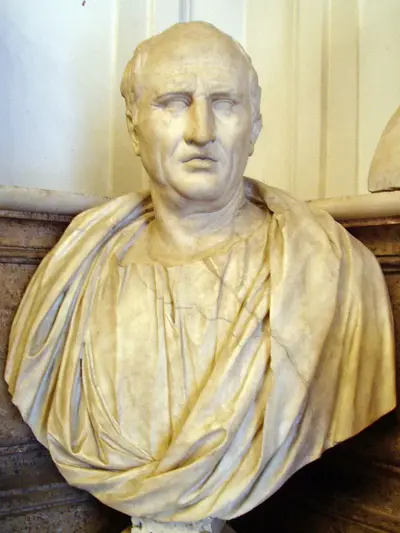
Marcus Tullius Cicero was a Roman statesman, orator, lawyer and philosopher, who served as consul in the year 63 BC. He came from a wealthy municipal family of the Roman equestrian order, and is considered one of Rome's greatest orators and prose stylists.
