Thomas Carlyle Quotes
Every new opinion, at its starting, is precisely in a minority of one.
Thomas Carlyle, 1795-1881, Scottish essayist and historian, Member of Parliament, On Heroes and Hero-Worship
Sourced by: Eigen's Political and Historical Quotations


This is not strictly true although it was in many cases in Mises career. However many of the great scientists, inventers, artists, entrepreneurs, and writers have been very positive about the government of the time. Many even credited the government for enabling or assisting their achievement. Even in Nazi Germany there were a few scientists who admired the Hitler government. However, in America, the educational system which gave so money contributors to humanity their start and preparation and in many cases government funding or previous research or facilities were recognized as instrumental in the development of the innovation. Many of the artists and writers of the 1940s-1960s credited the New Deal for their development and opportunity to create many of their great contributions. Internet entrepreneurs who changed the world in the late 20th century all acknowledge the Federal Government role in developing and deploying if the Internet. And there are few Nobel Prize winners who do not acknowledge Federal Scientific Research Grants and previous government funded and sometimes conducted (like the Human Genome) research that helped with or made the contribution. Even contributions like the telegraph and the railroad depended in initial government funding to make their contribution. Private capital could not be found to take the risk of financing these radically new ideas.

He was referring to the institutions in the particular fields. An established institution in education like a university might develop an innovation in astronomy or language translation, but not likely develop significant innovations in education. An established computer programming company might innovate the method of warehousing and shipping merchandise, but they are not likely to develop an innovative way of computer programming. That is typically done by a programming non-established firm or individual. There are a number of exceptions and this is not put forth as a general principle, but as a statistical observation. Established institutions are working harder and smarter to find ways of innovating regularly, and may succeed more frequently than the present.
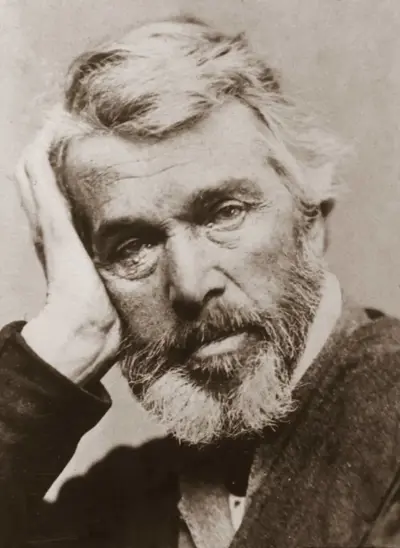
Thomas Carlyle was a Scottish historian, satirical writer, essayist, translator, philosopher, mathematician, and teacher. In his book On Heroes, Hero-Worship, and The Heroic in History (1841), he argued that the actions of the "Great Man" play a key role in history, claiming that "the history of the world is but the biography of great men". Other major works include The French Revolution: A History, 3 vols (1837) and The History of Friedrich II of Prussia, Called Frederick the Great, 6 vols (1858–65).
