Noam Chomsky Quotes
Even in the 1950s, President Eisenhower was concerned about what he called a campaign of hatred of the U.S. in the Arab world, because of the perception on the Arab street that it supported harsh and oppressive regimes to take their oil.
Chomsky, Noam. 9-11. Seven Stories Press, 2001.

The Defense Secretary opposed U. S. support for the founding of the state of Israel. See Clemenceau for an earlier expression of oil being a critical factor in foreign policy.

The Israeli’s had earlier been urged by America to give control of the Suez Canal back to Egypt. The Israeli’s held control of the Canal so that the Egyptians could not cut off ships from reaching Israel. The US had in exchange guaranteed that Israel would have free and unfettered access and to the sea. Egyptian dictator Gamal Abdul Nasser had just closed the Red Sea straights to the Israeli’s and the US was working on rolling that action back. However, some of the American oil companies privately were urging President Johnson to reneg on our commitments to our ally in order to ensure the profits of the oil companies. Johnson did not abandon Israel. ARAMCO made more money than ever. America was not finished in the Middle East.


Nasser was indeed planning an attack. Israeli intelligence had discovered it, and the Israeli’s informed President Lyndon Johnson who in turn called Kosygin. Nasser and the Arabs had miscalculated again and ended up being not only defeated in the war they wanted but totally embarrassed by the incredibly poor performance of the Arab armies who greatly outnumbered the Israelis but had no stomach for a fight.


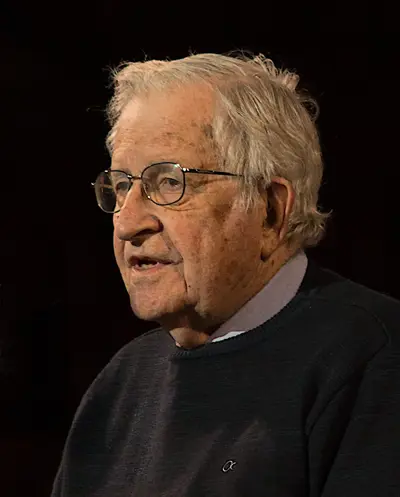
Avram Noam Chomsky is an American linguist, philosopher, cognitive scientist, historian, social critic, and political activist. Sometimes called "the father of modern linguistics", Chomsky is also a major figure in analytic philosophy and one of the founders of the field of cognitive science. He is Laureate Professor of Linguistics at the University of Arizona and Institute Professor Emeritus at the Massachusetts Institute of Technology (MIT), and is the author of more than 150 books on topics such as linguistics, war, politics, and mass media. Ideologically, he aligns with anarcho-syndicalism and libertarian socialism.
