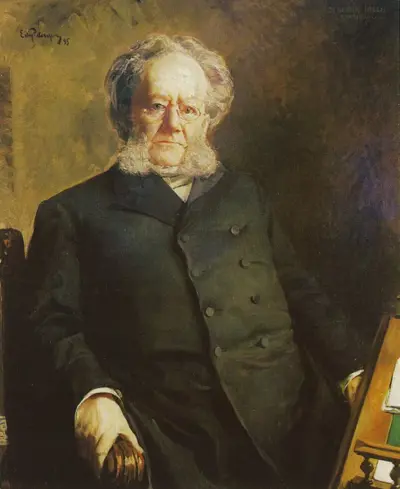
Henrik Ibsen Quotes
Enemy of the People
Such intellectuals as Max Eastman. John Dos Passos, and James Rorty were officially so classified.
Henrik Ibsen, 1828-1906, Norwegian Writer, Title of Play, American Communist Party, Official Label for Members or Supporters whose public views had become contrary to the party line, 1930s, Herbert Solow, Minutiae of Left-Wing Literary History, Partisan Review, March 1938
Sourced by: Eigen's Political and Historical Quotations
Eastman had broken with the Communist Party line and attacked Russian communism for its suppression of cultural freedom and insisting on making the artist a “soldier” in the struggle of world communism, This book supported dissident communist Leon Trotsky—considered an act of treason. Eastman and others were officially castigated. See {604277}.
Islam had been the center of intellectual thought in the world, until the clerics had decided that innovation itself was a sin and one that called for the death penalty. Although most non-Muslim religions went through stages of death for religious dissent. However, the Koran deals with every part of society. There is no separation of church and state. All knowledge is in the Koran the fundamentalist believes and anyone who expresses a new idea is not only wrong and a heretic, but is dangerous and must be executed. It is therefore not very surprising that the Islamic contributions to science, medicine, and the arts has been so small. The Islamic fundamentalists are opposed by Muslim modernists who try to change the Islamic culture but they are on the minority. Most religions have gone through bad earlier periods where dissent was heresy and warranted death. Fundamentalist Islam is the only one which bans original thought of any kinds even it does not contradict established doctrine.
Islamic modernists like Serageldin are many among the educated Muslims but their views are often drowned out by the violence and extremist statements of the fundamentalists.
The Boers were the decedents of the original Dutch farmers who came to South Africa. They were uneducated, lower class emigrants from Holland who, unlike the British who came later and were primarily interested in trade, were farmers and wanted to acquire the rich South African land for permanent settlement with no place for the blacks who were emigrating from Central Africa to acquire the same land. The result was a conflict between the whites of South Africa—the Boers who wanted to own as much land as possible and wanted the Blacks to be their slaves or very low wage workers with no rights at all, and the English whose laws made the Blacks citizens with rights. When the English ended up controlling South Africa the Boers with their own Afrikaner language and culture felt that the English whites were selling them out. The lower class Boers were insulted that under the English law, they were no better than Black farmers. They wanted to separate from the English so they could totally dominate the Blacks and strived for independence which led to the Boer Wars. Although the Boers lost to the English, they bred and populated South Africa and eventually came to dominate it politically. It was the Boers—also called Afrikaners—who were the ones who introduced Apartheid and created the racist society that caused so much difficulty in the late 20th century.
- Born: March 20, 1828
- Died: May 23, 1906
- Nationality: Norwegian
- Profession: Writer, Playwright
Henrik Johan Ibsen was a Norwegian playwright and theatre director. As one of the founders of modernism in theatre, Ibsen is often referred to as "the father of realism" and one of the most influential playwrights of his time. His major works include Brand, Peer Gynt, An Enemy of the People, Emperor and Galilean, A Doll's House, Hedda Gabler, Ghosts, The Wild Duck, When We Dead Awaken, Rosmersholm, and The Master Builder. Ibsen is the most frequently performed dramatist in the world after Shakespeare, and A Doll's House was the world's most performed play in 2006.