Herodotus Quotes
Egypt is the gift of the Nile.
Herodotus. The Histories. Translated by Aubrey de Sélincourt, Penguin Books, 2003, p. 95.


6th Baron Byron. England in the 18th Century was fascinated with Egyptian history, archeology, and art


Studies of Egypt were running headlong into contradictions of the age of man as dictated by the religious authorities of the time. Adam and Eve were fixed at about 4,000 BC by most authorities, but at that time the Egyptian civilization was quite fully developed. How did the Egyptians have the time to develop? Southall’s solution was this.


Under the WWI Peace Treaty the high court of Egypt was an International Court. President Wilson nominated Crabites to this court and he served there for 3 decades during which he became a world class expert in Middle Eastern affairs.


The reason for the secrecy was that he was informing Congress of the Lewis & Clark Expedition. Potentially, the Spanish, English or French might try to interfere with the expedition which was the precursor to American domination of the entire continent. Unfortunately, Jefferson’s plan for the Indians was not supported by many other Americans with the exception of New York State and the Iroquois remaining after many left after supporting the British in the Revolution. But the Iroquois who remained were already farmers in fixed communities and were experienced traders. Further, they had a complex governmental structure with many elements of democracy, and several had already succeeded in European educational settings. Their successful integration with the rest of New York can be demonstrated by the fact that New York is the only state where the average Native American Income is the same as the average white income, and there is no Indian gaming in New York. Jefferson’s vision, unfortunately, was never implemented in early the Westward Expansion.


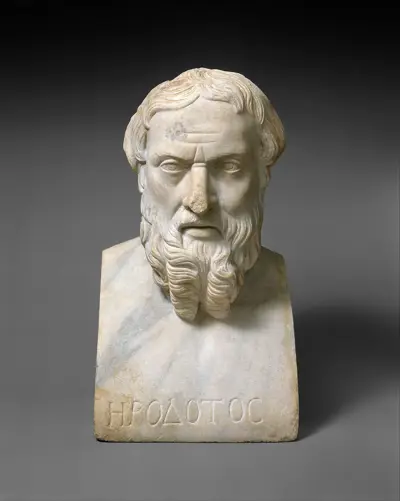
Herodotus (/hɪˈrɒdətəs/; Ancient Greek: Ἡρόδοτος, Hēródotos, Attic Greek pronunciation: [hɛː.ró.do.tos]; c. 484 – c. 425 BC) was an ancient Greek historian who was born in Halicarnassus in the Persian Empire (modern-day Bodrum, Turkey). He is known for having written the book The Histories (Ancient Greek: Ἱστορίαι Historíai), a detailed record of his "inquiry" (Ancient Greek: ἱστορία historía) on the origins of the Greco-Persian Wars. He is widely considered to have been the first writer to have treated historical subjects using a method of systematic investigation specifically, by collecting his materials and then critically arranging them into a historiographic narrative. On account of this, he is often referred to as "The Father of History," a title first conferred on him by the first-century BC Roman orator Cicero.
