Benito Mussolini Quotes
Corporative economy introduces order even into economy. If there is a phenomenon which ought to be well-ordered, which ought to be directed toward certain definite aims, it is precisely the economic phenomenon, which interests the whole of the citizens. Not only industrial economy ought to be disciplined, but also agricultural economy, commercial economy, banking economy, and even the work of artisans.
Benito Mussolini, 1883-1945, Italian Fascist dictator, Speech, Italian Senate, January 13, 1934
Sourced by: Eigen's Political and Historical Quotations


Some economic conservatives see little or no role for government. For many of them, in a free market there is no role for government. This quotation, from one of the economic heroes of the conservatives, shows that he not only saw a role for government, but believed that government was essential to the operation of a free market.


the largest economic and banking reform in decades The Dodd-Frank reform legislation was very complicated. It was extensively debated including attacks against provisions that were not even in the bill (See {632833}.) Few of the supporters and fewer of the opponents understood the bill. Many members on both sides had not even read the entire bill. It passed.


Greenspan accepted this as many other economists and financial regulators did. What they did not take into account was the incredible greed of many of the financial executive who were betting with their customers money, If the bet was right they, the shareholders and the customers all made out very well as they were highly leveraged. If the bet was wrong, the shareholders and customers lost a lot, and the financial executives only made their multimillion dollar salaries and bonuses (Many were actually were guaranteed their bonuses even if they put the company into bankruptcy.) Worse, they earned their money when they made their sales or earnings targets, but when the securities they bought went sour, even if the company had no funds left, the. It was “heads we all win and tails only I win.” The vested interests between the financial company executives, the shareholders, and the clients were divergent, and the customer was at the bottom of the money pole.

4 years after the Great Recession where major banks of America needed government bailouts to prevent failure the Administration and Federal Reserve board wanted to increase the capital requirements to increase the safety of the Banks. Essentially the banks would speculate and gamble with depositors’ money. If their investment paid off, there were large profits and bonuses for the executives. If it did not, they ran out of capital as they had very little of their own at risk. The government bailed them out and the executives got their bonuses anyway. The efforts to make the banks speculate with more of their own money were strongly opposed by the banks and bank executives.


Banks often lie. The system encourages them to do so. In a crisis, if a bank honestly says that it is not sure that it has enough cash and other liquid assets, others will not lend it any more money and depositors will rush to withdraw their money, thereby almost insuring a failure. The bank that lies, might weather the storm and survive.

At the time, the economy was virtually controlled by the banks and others in the finance, as opposed to businesses that produced things or provided non-financial services to consumers and business which was that had prevailed ever since the Great Depression, when New Deal legislation controlled the banks, stock markets, and other facets of the financial industry.


The Dodd Frank bill was designed, in the aftermath of the large bank induced meltdown of 2008 and the Great Recession, to regulate the banking industry so that no bank would be “too big to fail”. However, although the bill placed many restrictions on the banks to prevent much of their risky economic behavior, which the banks complained inhibited their growth and profitability. However, the bill did not put any limits on the size of the large banks and their critical proportion of the U. S. Financial System. If a bank was large enough, the government did not dare allow the bank to fail regardless of how profligate the Bank had been with its depositors’ money. So the shareholders made big money from the Bank’s risky behavior if it turned out well, and if not the taxpayers had to bail the banks out, because they were too big to fail without causing much of the rest of the country to also fail. Warren and others wanted a simple solution. Break up the large banks into smaller ones and then if any one of the small units makes poor investments, the bank could fail and other than its shareholders and creditors, the effect would not be so serious that the government could not allow the bank to go into bankruptcy. Mismanaged banks could fail like other mismanaged companies and not take down much or the rest of the country with them. But the banks lobbied to prevent that, and by 2014, 6 years after the taxpayers had to bail out banks that were too big to fail, many of the banks were twice as large as they were when they were already too big to fail.


The last sentence echoes a quotation of Napoleon. See {630664} .


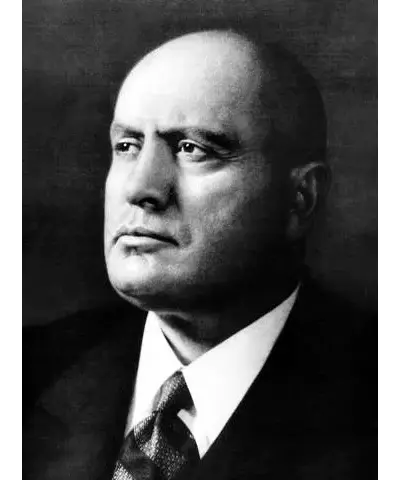
Benito Amilcare Andrea Mussolini was an Italian politician and journalist who founded and led the National Fascist Party. He was Prime Minister of Italy from the Fascist coup d'état in 1922 until his deposition in 1943, and Duce ("Leader") of Italian Fascism from the establishment of the Italian Fasces of Combat in 1919 until his execution in 1945 during the Italian Civil War. As dictator of Italy and founder of the fascist movement, Mussolini inspired other far right rulers such as Adolf Hitler, Francisco Franco, and António de Oliveira Salazar.
