John Paul Stevens Quotes
But I wound like people to think I was an honest judge and a good judge. And I always tried the reach the best result in every case.
Stevens, John Paul. The Making of a Justice: Reflections on My First 94 Years. Little, Brown and Company, 2019.

This quotation appears on several courthouses in the United States.

He is remembered today as the "Hanging Judge" of the American Old West. The two statements of his motto are contradictory unless all trials were perfect and all police, prosecutors, defense lawyers, defendants and witness always told the truth, and never made mistakes. This judge never followed the basic principle laid down by Blackstone regarding criminal law. See {594956}.


Watkins was the first Dallas County Black DA. He was being interviewed because DNA testing proved that a man who had served 30 years in prison for rape and robbery, could not have committed the crime, and he had just been released. Watkins quotation was very significant because it set forth a philosophy that while extant in other areas of the country is almost unheard of in Texas, where there have been more innocent men convicted than in any other state. DAs in Texas usually fight every attempt to examine old evidence with modern tools.


She was a judge before she had been a member of Congress.


This document was a type of Magna Carta but far earlier.

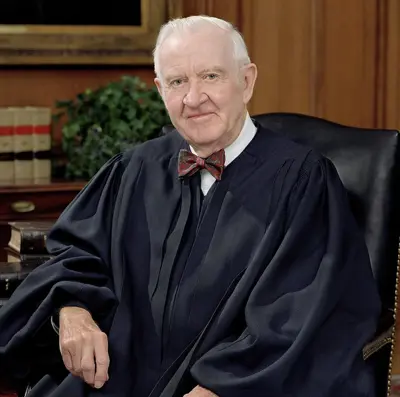
John Paul Stevens was an American lawyer and jurist who served as an associate justice of the United States Supreme Court from 1975 until his voluntary retirement in 2010. At the time of his retirement, he was the second-oldest-serving justice in the history of the court and the third-longest-serving justice. At the time of his death, he was the longest lived Supreme Court justice ever. His long tenure saw him write for the court on most issues of American law, including civil liberties, death penalty, government action and intellectual property. In cases involving presidents of the United States, he wrote for the court that they were to be held accountable under American law. A registered Republican when appointed who throughout his life identified as a conservative, Stevens was considered to have been on the liberal side of the court at the time of his retirement.
