Tariq Ramadan Quotes
Being Muslim has become synonymous with pointed questions, with tension and mistrust, even with conflict. It has become a global phenomenon with profound consequences for inter-communal relations, political rhetoric and policies at the local, regional, national and international level.
Ramadan, Tariq. What I Believe. Oxford UP, 2009.


The journalist and author, one of the most influential Italian journalists and intellectuals, was then dying of cancer and came out of retirement to warn about the great threat that she believed that Islam was for the West. See {587753} for her earlier warning. While at the surface, she appears to be a very bigoted individual, her main concern about Islam in general and for European immigration in particular had an intellectual and sophisticated base. Specificly, was 1) Islam is the ONLY religion that teaches and demands the transcendence of nationalism in a world that is organized around nations. It demands a concept of Muslim land as opposed to Egyptian land or Pakistani land. 2) It is overtly sexist and requires sexism of its adherents as opposed to other religions where sexism is traditional and cultural and not as theological. 3) It is anti democratic and requires adherents to conflate religion and government. However, what Fallaci was unaware of was the reform and modernist movement within Islam who argued for a modern, democrative evolution of the religion much as what has occurred with Christianity and Judiasm and other religions.

Nigeria was about equally divided into Muslims who dominated the North and Christians and Animists who dominated the South. The former were intent on making Sharia—Islamic Law—the law of the nation and the latter were equally passionate to avoid it. Muslim protests got very violent including murdering innocent civilians; the Christians threatened to retaliate.


This sura illustrates why peace treaties between Islamic and non Islamic countries are difficult to negotiate and enforce. For some fundamentalist Muslims, even making a peace treaty with Israel would constitute a transgression of the word of God. Nonetheless, the first treaty that the United States ever made was with a Muslim nation—Tripoli.
He was a brutal, sadistic war criminal who was assassinated by one of his many enemies in 2000 before he could be brought to trial.
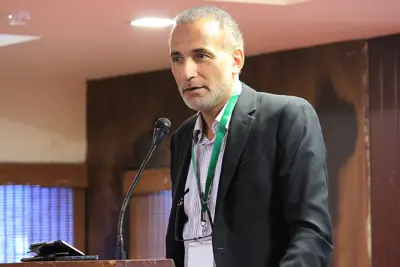
Tariq Ramadan is a Swiss Muslim academic, philosopher, and writer. He was a professor of contemporary Islamic studies at St Antony's College, Oxford and the Faculty of Theology and Religion, University of Oxford, but as of 2018 is taking an agreed leave of absence. He is a visiting professor at the Faculty of Islamic Studies at Hamad Bin Khalifa University in Qatar, and the Université Mundiapolis in Morocco. He is also a senior research fellow at Doshisha University in Japan. He is the director of the Research Centre of Islamic Legislation and Ethics (CILE), based in Doha. He is a member of the UK Foreign Office Advisory Group on Freedom of Religion or Belief. He was elected by Time magazine in 2000 as one of the seven religious innovators of the 21st century and in 2004 as one of the 100 most influential people in the world and by Foreign Policy readers (2005, 2006, 2008–2010, 2012–2015) as one of the top 100 most influential thinkers in the world and Global Thinkers. Ramadan describes himself as a "Salafi reformist".
