Vitruvius Quotes
As for philosophy, it makes an architect high-minded and not self-assuming, but rather renders him courteous, just, and honest without avariciousness. This is very important, for no work can be rightly done without honesty and incorruptibility.
Vitruvius. The Ten Books on Architecture. Translated by Morris Hicky Morgan, Harvard University Press, 1914, p. 8.


This is one of the proverbs of King Solomon of the Jews, son of King David.


Jefferson was not anti-Christian as some accuse him. He was a great admirer of Jesus’ life and philosophy. He did object to the non-ethical aspects of Christianity, miracles, dogma, organized churches. See {611664}. Jefferson even went so far as to write his own version of the Bible—New Testament sometimes called the “Jefferson Bible”—where he translated the material and then extracted the ethical principles leaving out everything else.


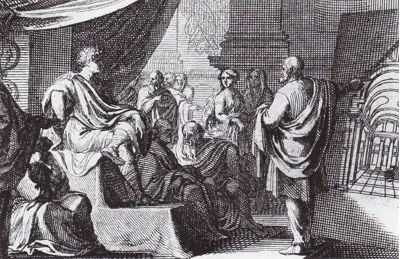
Marcus Vitruvius Pollio (/vɪˈtruːviəs ˈpɒlioʊ/; c. 80–70 BC – after c. 15 BC), commonly known as Vitruvius, was a Roman author, architect, and civil and military engineer during the 1st century BC, known for his multi-volume work entitled De architectura. He originated the idea that all buildings should have three attributes: firmitas, utilitas, and venustas ("strength", "utility", and "beauty"). These principles were later widely adopted in Roman architecture. His discussion of perfect proportion in architecture and the human body led to the famous Renaissance drawing of the Vitruvian Man by Leonardo da Vinci.
