Andrew Carnegie Quotes
All Americans are kings.
Andrew Carnegie, 1835-1919, Industrialist and Philanthropist, Comment to a friend, Quoted on PBS, The American Experience: The Richest Man in the World, August 20, 2007
Sourced by: Eigen's Political and Historical Quotations


President Benjamin Harrison and Congress proclaimed that October 31, 1892 be a national celebration of the 400th Anniversary of Columbus landing in America. Bellamy represented a juvenile weekly publication and was named chairman of the committee to conduct the celebration. A first draft of the pledge was written by James B. Upham, a staff member of the publication. The words "under God" were added in 1952 by an Act of Congress. The original had “to my flag.” The pledge was first used publicly at the Chicago World’s Fair on October 21, 1892. It was not endorsed by Congress until 1942. It is officially recognized as law in 36 United State Code 172.


Jefferson had deliberately modified John Locke’s phrase “life, liberty and property.


Actually originated by William Jennings Bryan in a 1900 campaign speech. See {640984} . The slogan became the name and first line of a poem and also a song. See {609937}


Ironically most American politicians are independent of crowned-kings, but are very depended on money-kings and land-kings for campaign contributions and in some cases, jobs if they are defeated at the polls.

Although not particularly noticed at the time, FDR was the first person to use the term, “Human Rights” which is today in all our vocabularies.

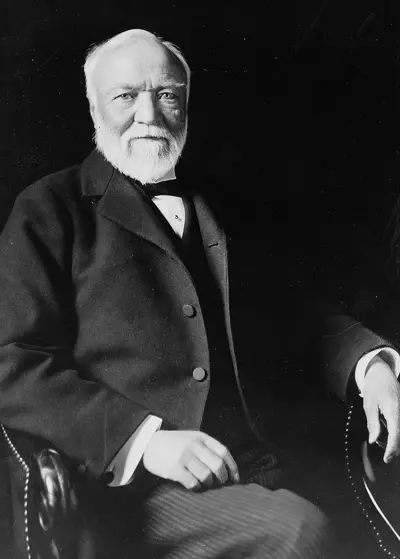
Andrew Carnegie was a Scottish-American industrialist and philanthropist. Carnegie led the expansion of the American steel industry in the late 19th century and became one of the richest Americans in history. He became a leading philanthropist in the United States and in the British Empire. During the last 18 years of his life, he gave away ~$350 million (roughly $5.2 billion in 2019) to many charities, foundations, and universities – almost 90 percent of his fortune. His 1889 article proclaiming "The Gospel of Wealth" called on the rich to use their wealth to improve society and stimulated a wave of philanthropy.
