John Locke Quotes
… adjudged not to him who had the truth on his side, but by the last word in the dispute.
John Locke, 1632-1704, English Political Philosopher, Warning of the result if a charge is not rebutted, An Essay Concerning Human Understanding
Sourced by: Eigen's Political and Historical Quotations


When whites first came to America, the Iroquois, were the most sophisticated Native Americans. They were actually a confederation of 5 different tribes each of which was composed if many clans. Although fierce warriors, they had agreed not to fight each other and to assist if any were attacked. They developed a strong agricultural base, to go with the fishing and hunting, and their confederation were very aggressive and sophisticated traders taking them far from their upstate New York “capitol.” Their governmental structure was quite sophisticated with an elaborate, formal, system of checks and balances, multi-cameral legislatures that recognized numbers of citizens, power and wealth, and even cultural traditions. They were literate, capitalistic and globalistic in that they wanted to trade with all. They had written laws, and women had a role that was unique in world history in that only women owned property in a matrilineal society. Further, it was only the Clan Mothers who voted for the 50 Sachems (~Senators)—but their selections had to be accepted by the people they represented. Ironically the descendants of the Iroquois who remained in New York became a very successful Native American group. In the 2000 census, the average Indian in New York State earned the same income as the average White with no Indian gambling money.


This is one of the earliest American articulation of the 12 man jury.


Some democratic cultures are very distrustful of government bureaucracies and prefer to resolve conflicts through the courts where the process in in general much more transparent. The U. S. is not the only example. Israel is even more litigious.


Reagan, Ford, Bush, Clinton


The French had arrived there first an “claimed” the area with a tiny military contingent under Lieutenant Marchand. However, the British arrived afterward with a much larger military force. London and Paris decided that the French should withdraw in favor of the British. Delcasse had been right. Another case of “might makes right.”

Islam was not very strong at this point and the followers of Muhammad were relatively few and Medina area contained Arab Non-Believers, Jews as well as the new Muslims. Muhammad drew up this document and got the non Muslims to agree to it. What is fascinating is that they bought into the idea that Muhammad would be the judge and final arbitrator of all disputes that were not resolved locally. The non Muslims agreed to this because Muhammad had been judging disputes for several years for those who would submit their cases to them. In a time of inconsistency, corruption, capriciousness and arbitrariness, Muhammad had developed a remarkable reputation for fairness, consistency, objectivity, and complete honesty. He could not be bought as most judges were at the time. He simply had demonstrated that he was the best man for the job.

Baker led the legal team for George W. Bush and had filed numerous lawsuits including to the U. S. Supreme Court.


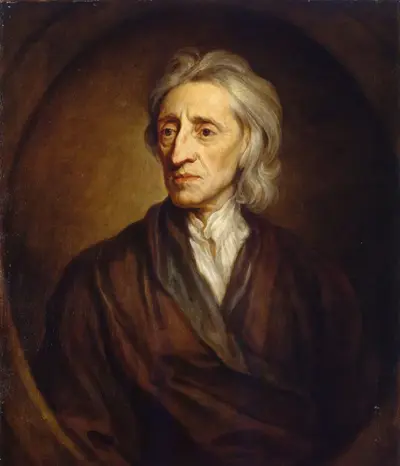
John Locke FRS was an English philosopher and physician, widely regarded as one of the most influential of Enlightenment thinkers and commonly known as the "Father of Liberalism". Considered one of the first of the British empiricists, following the tradition of Sir Francis Bacon, Locke is equally important to social contract theory. His work greatly affected the development of epistemology and political philosophy. His writings influenced Voltaire and Jean-Jacques Rousseau, and many Scottish Enlightenment thinkers, as well as the American Revolutionaries. His contributions to classical republicanism and liberal theory are reflected in the United States Declaration of Independence.
