Pope John Paul II Quotes
A promising process of dialogue can be disrupted by a premature or inadequate involvement of public opinion.
John Paul II, 1920-2005, Karol Jozef Wojtyla, Catholic Pope, Speech to Austrian Bishops, June 21, 1998
Sourced by: Eigen's Political and Historical Quotations


1st Earl Lloyd-George of Dwyfor

When there are disputes between nations, sometimes one or both of the countries take the position that the other is so wrong and immoral that to negotiate with them per se gives them a credibility which they do not deserve. So at times one or both of the opponents places preconditions on discussions. Some politicians and governments have had a belief that negotiating with and enemy is a sign of weakness, and the reality is that often the other side characterizes attempts at negotiations as an indicator that they are faring well under the theory that the other side would not negotiate if they didn’t have to. Those governments which have a policy of talking to everyone under any conditions, avoid this dilemma as talks are not a sign of anything but their normal foreign policy.


This is an interesting historical quotation because it shows the role of the Queen in the English Government at the middle of the 19th century. What the quotation shows is that the drafts of significant foreign policies were sent to the young 29 year old Queen for approval. However, her review was not perfunctory, In {630732} it showed how she analyzed proposed policies and pointed out flaws and shortcomings. In this quotation she not only criticized a part of the draft policy but actually wrote her own copy to be included. War was then raging in Lombardy between the Austrians under Marshal Radetzky and the Piedmontese under the King of Sardinia and she believed the Palmerston draft did not do enough to make the Austrians see England as an objective party. And she wanted to be much more proactive and have the British Foreign Ministry mediate the conflict. This would be like a President of the United States taking a draft of a foreign policy from the State Department, instead of either approving or disapproving it, redrafts it to add some additional elements and make the language more comfortable for the parties. And she did this when by U. S. standards she was not old enough to even run for Congress. (And women in the United Kingdom could not even vote.) Note that the formality of the time required that the Queen refer to herself in the third person and not the first.


The Secretary of State had obtained an agreement of Israel and the Palestinians to open Peace Talks. The press immediately wanted to know who was saying what to whom and what positions the parties had. However, this was a classic example where transparency would make successful negotiations impossible—it would end the negotiations before the parties could even discuss possible alternatives.


Erecat was expressing his frustration with the peace negotiations and the lack of progress.

When there is a serious problem with another country and it appears that military force may have to be used, he and most sophisticated policy makers argue that we should always try diplomacy first. If that does not work, then the military option is still open. If it does work, war or other military action is always available as an option. When politicians do not want to try diplomacy, it is usually that they have an ulterior motive for war and/or military force. Some urge caution with this principle in all cases as sometimes it gives the enemy time to regroup and rearm and he gets stronger by stringing out the negotiations with no intention of a diplomatic solution. In some other cases, as Iran in the second decade of the 21st century when they were suspected of developing a nuclear weapon. The Israeli right wing and some American conservatives wanted no delay in use of military force as that might allow the Iranians to complete an operational message. President Obama and most Americans favored strong economic sanctions with diplomacy first.


George W. Bush. Reference to foreign policy situations like Syria where there is a major conflict or contest between two forces, each of which is fatally flawed from an American point of view.


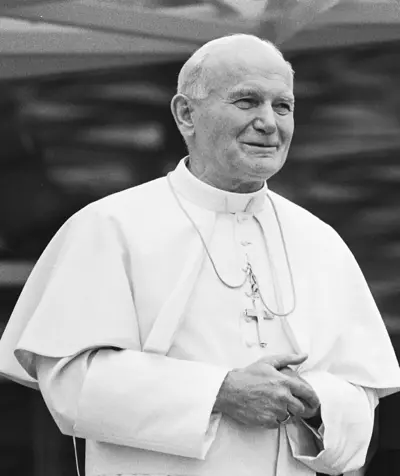
Pope John Paul II was the head of the Catholic Church and sovereign of the Vatican City State from 1978 until his death in 2005. He was elected pope by the second papal conclave of 1978, which was called after John Paul I, who had been elected in August to succeed Pope Paul VI, died after 33 days. Cardinal Wojtyła was elected on the third day of the conclave and adopted the name of his predecessor in tribute to him. John Paul II is recognised as helping to end Communist rule in his native Poland and the rest of Europe.
