Swami Vivekananda Quotes
A man, and a cat, and a dog, are all animals. These particular examples, as man, or dog, or cat, are parts of a bigger and more general concept, animal. The man, and the cat, and the dog, and the plant, and the tree, all come under the still more general concept, life. Again, all these, all beings and all materials, come under the one concept of existence, for we all are in it.
Vivekananda, Swami. The Complete Works of Swami Vivekananda, Vol. 1. Advaita Ashrama, 1989, p. 373.


The law is far behind science in many areas, but one dramatic one is the notion of life itself. For the criminal law and for benefits entitlement, when life begins and when it ends are traditionally important. Yet is a very complex question in many cases. Abortion is another controversial area. Under ancient Jewish Law, a fetus is considered a living person when the crown of the head can be viewed from the mother’s vagina. Modern science has demonstrated that depending on how you define life, the fetus itself is alive during the pregnancy. But if one goes further with modern science, the sperm and egg cells are alive before conception. So are millions of other cells in the human body which we kill routinely—some intentionally as when we take an antibiotic to terminate “undesirable” bacteria. Many orthodox Hindus who will not kill living animals will kill living cells such as when they eat yogurt. Scientists have in recent times resisted trying to define the term “living” not only because of its complexity, but because almost any definition would soon be obsoleted by new knowledge which is accumulating so rapidly. Science simplifies and clarified many phenomena, but also makes others much more complex.


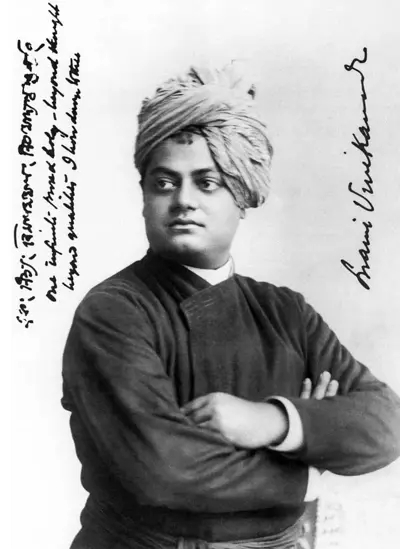
Swami Vivekananda, born Narendranath Datta (Bengali: [nɔrendronatʰ dɔto]), was an Indian Hindu monk. He was a chief disciple of the 19th-century Indian mystic Ramakrishna. He was a key figure in the introduction of the Indian philosophies of Vedanta and Yoga to the Western world, and is credited with raising interfaith awareness, bringing Hinduism to the status of a major world religion during the late 19th century. He was a major force in the contemporary Hindu reform movements in India, and contributed to the concept of nationalism in colonial India. Vivekananda founded the Ramakrishna Math and the Ramakrishna Mission. He is perhaps best known for his speech which began with the words "Sisters and brothers of America ...," in which he introduced Hinduism at the Parliament of the World's Religions in Chicago in 1893.
